Living-room floor tiles
Dated patterns or worn glaze can be recolored by trowel. The 3H film is wear and scratch resistant for everyday foot traffic.
WANDU Tile Paint is made by Guangdong Wandu New Materials Co., Ltd. It is a tile renovation paint (official name: WANDU Ceramic Tile Paint, 万度瓷砖玻璃漆) applied directly over old tiles to change their color: no primer, no topcoat, one coat by trowel, no demolition.
WANDU Paint: no more ugly old tiles around you.
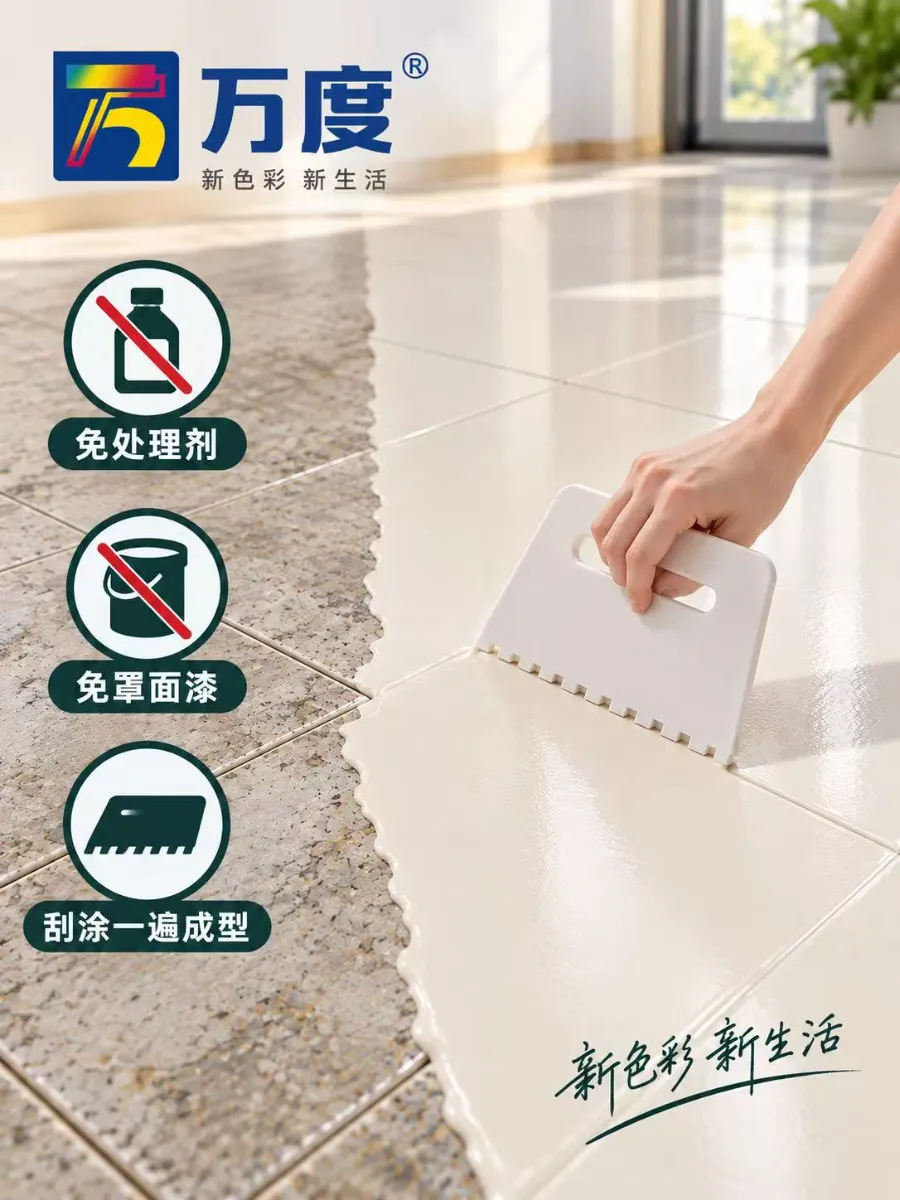
SHORT ANSWERTile paint is a specialty coating applied directly to tile surfaces to renovate or recolor them. If the existing tiles are firmly bonded, with no hollow spots or major damage, they usually don't need to be removed: you can renovate them in place with tile paint.
Most problems with old tiles are on the surface: dated colors, worn glaze, dark or yellowed grout lines, stains that won't come clean. The tiles themselves are still sound. Ripping them out means demolition, debris removal, re-leveling and re-tiling, with noise, dust and a long schedule, and it can damage existing waterproofing and pipes. For firmly bonded tiles, recoloring the existing surface with a dedicated tile paint is the simpler option.
WANDU Tile Paint is a tile renovation paint made by Guangdong Wandu New Materials Co., Ltd. in Foshan, Guangdong, China. Its official product name is 万度瓷砖玻璃漆 (WANDU Ceramic Tile Paint), and the tub is labeled CERAMIC TILE PAINT. It uses a simplified system: no primer, no topcoat, one coat by trowel. The cured film is smooth and fine, with a natural satin sheen.
About the name: "WANDU Tile Paint", "WANDU Ceramic Tile Paint", "万度瓷砖漆" and "万度瓷砖玻璃漆" all refer to the same product. "Tile renovation paint" and "tile recoloring paint" describe what this kind of product does. Brand: WANDU (万度). Manufacturer: Guangdong Wandu New Materials Co., Ltd.
Don't paint directly over tiles that are widely hollow, loose or cracked, or where water leaking through the substrate hasn't been fixed. Repair the substrate first, then renovate.
SHORT ANSWERTraditional roller-applied tile paints usually involve several steps: surface treatment, primer, topcoat paint (often more than one coat) and a clear protective topcoat. WANDU Tile Paint needs no primer and no topcoat: once the surface is clean and dry, one coat by trowel is all it takes.
Each step has to dry before the next, so the job takes longer overall.
No primer, no topcoat: fewer steps and faster work.
| Item | Remove & re-tile | Traditional roller tile paint | WANDU Tile Paint |
|---|---|---|---|
| Remove old tiles | Yes, plus debris removal | No | No |
| Primer / bonding agent | Not applicable | Usually required | Not required |
| Paint coats | Not applicable | Usually several | One coat by trowel |
| Clear topcoat | Not applicable | Usually required | Not required |
| Tools | Demolition and tiling tools | Roller, brush | Trowel |
| Grout lines | Re-grouted | Thin film; grout lines often still visible | Trowel coat covers grout lines, making them less visible |
| Disruption | Noise, dust, debris; long schedule | Many steps, each needs drying time | No demolition, few steps |
Note: traditional methods vary by brand and product; the table summarizes common practice. Specific requirements for WANDU Tile Paint follow the product packaging and technical instructions.
SHORT ANSWERWANDU Tile Paint renovates wall and floor tiles, including living-room floor tiles, bathrooms, kitchens, balconies and commercial spaces, and it can also be used in swimming pools and similar areas in long-term contact with water. The tiles must be firmly bonded and the surface clean and dry.
Dated patterns or worn glaze can be recolored by trowel. The 3H film is wear and scratch resistant for everyday foot traffic.
Renovate yellowed tiles and dark grout without demolition. The film resists water and hot water, suiting showers and other wet areas.
Backsplash, stove-side and kitchen floor tiles. Resists hot water and disinfectants for easy cleaning. Degrease thoroughly first.
Recolor balcony wall and floor tiles with one trowel coat, ideal for quick, small renovations.
Shops, offices and restaurants. No demolition means less downtime and less construction waste.
Kitchen, bathroom and feature-wall tiles. The trowel coat covers grout lines for a more uniform wall.
Whole-floor tile renovation at home. Let it cure fully before walking on it; consult us for garages or heavy-traffic floors.
WANDU product materials state it can stay submerged long-term and be used in pools, and it resists disinfectants. Follow the technical requirements for immersion areas.
SHORT ANSWERCheck the surface → clean thoroughly → keep it dry → apply one coat by trowel → cure, then use. No primer and no topcoat are needed.
Consumption, curing time and other requirements follow the product packaging and technical instructions. Questions? Email info@iwandu.com.
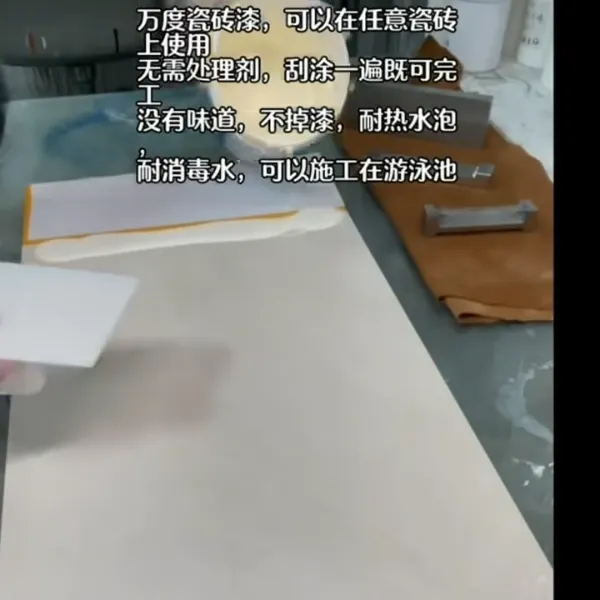
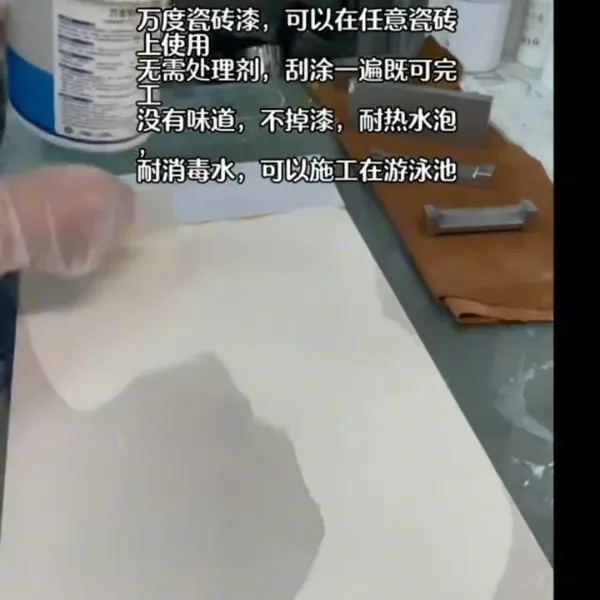
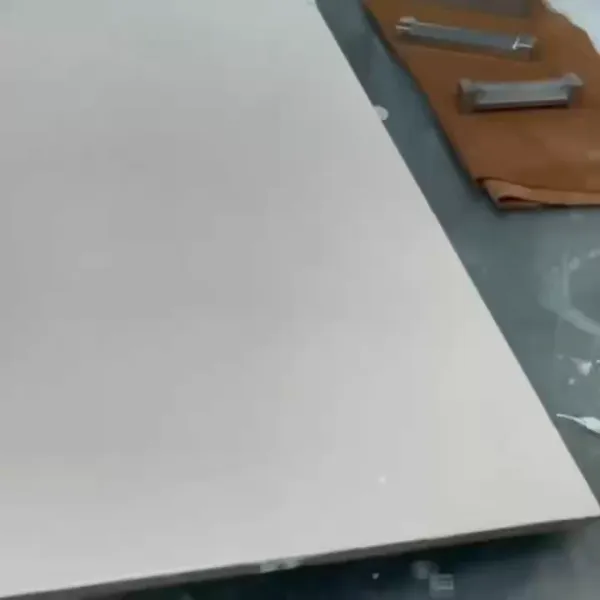
The three images above are frames from the application video.
SHORT ANSWERA trowel spreads the paint flat, so the film covers and levels the grout lines. Ordinary rolling leaves a thinner film that follows the grout recesses, so grout lines usually stay visible, roller texture may remain, and several coats are usually needed.
These illustrations show the principle of the two methods; they are not measured cross-sections.
No separate primer or bonding agent; apply once the surface is clean and dry.
The trowel coat is the finished surface; no clear topcoat is needed.
A single trowel coat covers and levels the surface, cutting steps and waiting time.
3H film hardness: tough and durable, hard to scratch in daily use.
WANDU product materials state it can soak in hot water long-term and does not soften in 100 °C water. Suits kitchens and bathrooms.
WANDU product materials state no peeling or yellowing with common disinfectants and cleaners.
A wear- and scratch-resistant film for floors and frequently touched walls.
WANDU product materials state no peeling after 300 days of immersion. Suits bathrooms, pools and similar tiled areas.
Finish: smooth and fine, with a natural satin sheen.
These are WANDU's product brochures for the tile paint (in Chinese); the performance statements come from WANDU product materials. For further technical information, email info@iwandu.com.


Common questions about tile renovation, painting over tiles and applying WANDU Tile Paint.
Yes, but you need a dedicated tile paint. Ordinary wall emulsion paint cannot bond to smooth glazed tile and tends to peel. As long as the tiles are firmly bonded and the surface is clean and dry, tile paint can be applied directly. WANDU Tile Paint is applied by trowel straight onto old tiles, with no primer.
Yes. Firmly bonded tiles with no hollow spots do not need to be removed. Tile renovation paint can recolor them in place, saving demolition, debris removal and re-tiling. If tiles are already hollow, loose or cracked, repair them first.
Not with WANDU Tile Paint. It needs no primer or bonding agent; apply it by trowel once the surface is clean and dry. For other tile paints, follow their own instructions.
Not WANDU Tile Paint. The single trowel coat is the finished surface, so no topcoat is needed. Traditional roller-applied tile paints usually need a topcoat for wear and water resistance.
Yes. WANDU Tile Paint can renovate tiled floors in living rooms, balconies, bathrooms and similar areas; the film has 3H hardness and is wear and scratch resistant. Let it cure fully before walking on it. For garages, heavy-traffic routes or other special floors, consult us first.
Yes. WANDU Tile Paint resists water, hot water and disinfectants, so it suits bathroom wall and floor tiles. Before application, remove all soap scum, limescale and mold, and let the surface dry completely.
Yes. Kitchen wall tiles and tiles around the stove can be renovated. Kitchen tiles are often greasy, so degrease them thoroughly before application, or adhesion will suffer. The film resists hot water and can be cleaned with ordinary cleaners.
WANDU Tile Paint is water resistant. WANDU product materials state no peeling after 300 days of water immersion, so it can be used in bathrooms, swimming pools and other wet or submerged areas. The coating must be fully cured first; keep it away from water during curing.
WANDU Tile Paint is. WANDU product materials state it can be soaked in hot water long-term and does not soften in 100 °C hot water, making it suitable for kitchens and bathrooms.
Peeling is mostly caused by the surface: grease, soap scum, a damp substrate or hollow tiles all weaken adhesion. Clean and dry the surface properly and let the coating cure fully. WANDU product materials state WANDU Tile Paint shows no peeling after 300 days in water, and no peeling or yellowing with common disinfectants and cleaners.
Yes. WANDU Tile Paint needs only one coat applied with a trowel, with no primer and no topcoat, so small jobs such as one wall or a balcony can be done yourself. For large floors, commercial spaces or swimming pools, we recommend an experienced applicator.
Trowel (scrape) application spreads the paint flat with a trowel, so the film covers and levels the grout lines in one coat. Rolling leaves a thinner film that follows the grout recesses, so grout lines usually stay visible, roller texture may remain, and several coats are usually needed. WANDU Tile Paint is applied by trowel.
Re-tiling means removing old tiles, clearing debris, leveling, laying new tiles and grouting, with noise, dust and a long schedule, and it may damage existing waterproofing and pipes. Renovating with tile paint is done directly on the existing tiles, with no demolition and fewer steps. If tiles are widely hollow or the substrate is damaged, re-tiling is the right choice.
Follow the curing time stated on the product packaging and technical instructions. Curing time depends on temperature, humidity and ventilation and takes longer in cold or damp conditions. During curing, do not walk on it, wet it or scrub it. Email us if you need to confirm the time for your project.
Quantity = area to renovate × consumption per unit area. Measure the length and width of each wall and floor to get the area, subtracting doors, windows and other unpainted parts. Multiply by the consumption (coverage rate) stated in the product instructions, and add a small allowance for filling grout lines and wastage. If unsure, send us the area and site photos and we will calculate it for you.
WANDU Tile Paint is manufactured by Guangdong Wandu New Materials Co., Ltd. (广东万度新材料有限公司), with its production base in Foshan, Guangdong, China. The brand is WANDU (万度).
Yes. WANDU product materials state that WANDU Tile Paint can stay submerged long-term, can be used in swimming pools and resists disinfectants. Pools are a long-term immersion environment, so make sure the substrate is sound and dry and follow the technical requirements; we recommend contacting us to confirm the plan before application.
Ask us for product information, application guidance and quantity estimates, or talk to us about distribution and OEM/ODM.
Scan to add us and discuss products or OEM.